|
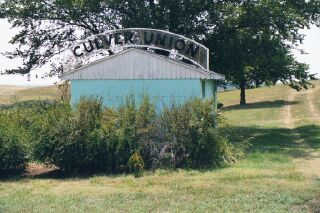
Culver
Nestled in the Saline River valley stands the
small town of Culver Kansas. Homesteaders began to
settle in this region after the Civil War.
One of these was George W. Culver who had served as
a Second Lieutenat in the Second Colorado Cavalry during the War between
the States.
Culver, originally from New York State,
rode across Kansas until he found a
place to his liking. On the south bank
of the Saline River he built a house on his homestead. He
helped organize Tripp School District west of the present location
of Culver. He was a man of high moral standard.
In 1868 Sioux Indians, together with
some Cheyenne and some Dog Indians began
raiding settlements along the Smoky Hill, Saline and Solomon Rivers.
One Indian fight was at Table Rock,
southwest of the present of Culver. It is believed that there
were some Indian fights on the Walt Hannebaum farm
four miles west of Culver on the Saline River. Many arrowheads have
been found in that vicinity.
Culver lost his life on Beecher, Island, in the battle of the Arickaree.
During the battle he called several
friends to his side and told them
that he wanted to make his will.
All of his property along the Saline was
to go to his Army companions. He
was to be buried where he fell .
That afternoon about two o'clock
a bullet hit him and Wm. H. McCall. The bullet stunned
McCall and went on to kill Culver.
It was September 17, 1868. The battle
survivors returned home and named Culver's
homestead in his honor. Later this became
the community of Culver,
George Culver was buried at Ft. Wallace in November 1868.
The Stage Coach line used to follow the Saline River for some miles.
Wheel tracks are still visible on
the Hannebaurn farm four miles west of
Culver. There are also tracks near
Marvin Gorrell's home southeast of Culver.
The Culver Post Office was established on April
14, 1873.
The first justice of the Peace was W.M.
Wright in 1876 and the first doctor
in Culver was Dr. E.L. Lutz. The charter
for the Methodist Church was drawn up on September 25,
1886;and the Presbyterian Church was organized January 19, 1878.
Some Court Proceedings in Culver in 1879
were: The State of Kansas vs. Agnew Lehman.
It was charged by Levi Cornish that one
Agnew Lehman did enter upon the range
of said Levi Cornish and cut the picket rope
from the head of said Levi Cornish's cow and
steal and carry away about 10 feet of said Levi Cornish's
picket. Lehman was found guilty and fined $1.00, along with court
costs of $14.95.
In 1886-87 the Kansas Pacific Railroad
built a line here.
The town of Culver was moved from a mile north to its present
location to be near the railroad sometime in 1886.
In building the railroad, mules and slips were
used. One crew would be busy building a mile of roadbed,
and another crew would build its roadbed one
mile farther west. In the winter
two tents with stoves were set up, one for
the mules and the other for the men. The mules were
watered in the river.
Culver was incorporated In 1909. It
was to be a city of the third class
and be known by the name of "The City of Culver".
The inhabitants at that time were given to number 300.
The Culver High School was started
in 1903 by Rube Applebaugh. He taught two years
there. The IOOF Hall was built in 1913.
There is one important building left in Culver. It is built of
cement and is about 8 feet by 9 feet in
size, with one small barred window and 1 sturdy metal door.
This building is the jail which in in
forty years has only had two occupants, one dog
and one man. The dog, belonging to Rube Applebaugh
was set upon by a pack of dogs and put in jail by Frank Gray, who
was Marshal of Culver at the time,
to protect it until the owner could
claim it. The man jailed was a harvest hand
who got drunk. He was locked in the jail
to sober up, but it was almost more trouble
than it
was worth He broke out and had to be chased, caught, and re-jailed.
So the Jail echoes to silence year in and year out, except on occasions
when, so "they say" -- some
men of the town gather there to play cards.
It's quiet in there so they can concentrate.
The fire house is a quaint structure with
an old fashioned steeple and a big fire bell.
In the fire house there used to be an ancient fire cart. When
there was a fire, the fire bell
was rung and then some of the men would come running
to get the heavy fire wagon. They had to pull it by hand. "The
fire wagon saved a restaurant back in the days before World
War One," said Marshal Gray. There
was an
accident that occurred with it. The men
were on their way to put out a fire at
the time, in the excitement, a man was knocked down and run over by
the cart.
According to the July 8, 1915 issue of the Culver
Record,
Carl Judge was Publisher, and H.L. Perdersen
was Editor and Manager.
The rate of a subscription was $1.00 in
advance. The paper was 75 cents
for a year, extra copies were each 2 cents and sample copies were
free.
When Frank Gray was marshal of Culver,
he would honor the dead taking donations. A
knock on any door, whether at the
local pool hall or Ladies' Guild, would
command him immediate respect.
When notified of a Culver funeral , the
77 year old ex-cowboy would reach for
his hat and begin a house to house
tour of the town. Two hours later,
he had
visited all of Culver's fifty to sixty homes for floral donations.
Culver's one man flower collection service was
started in 1937. A group of women sought Gray's
help in the project. He not only helped but took over comple charge.
Gray, who called himself a jack-of-all
trades, arose to any job request. A native of
his community, he was a professional horsebreaker for several
years, a farmer, mail transporter, and
cowboy, driving cattle in the Glen Elder and Republic County areas.
The Saline River has caused floods In
Culver in the years
of 1903, 1928, 1932, 1935, 1951 and 1957.
The flood of 1951 was 10 to 15 f.
deep south of the depot. It stood
at least 4 feet deep in some places in
town. There were about eight floods during
the three months of June
July, and August. When the water was the
deepest, there
were only about 15 houses that didn't
have water in them. The school house was used
by families who had to move out. The people were
there for about two days
All gardens and crops were washed out.
Before the floods
came that year the bridge south of town had
fallen in. There was no one on the bridge at
the time, but there had been quite a bit of traffic that day.
The following is from the Culver
Herald on April 20,
1932; Wheat .40 eggs .07 butter .15. In
1935 the following appeared: Will trade -a few subscriptions
to the Culver Herald, new or renewal,
for butter, eggs, beef, potatoes, milk, or other produce. What
have you?
In November of 1960 the installation of a water system was compled.
On August 31, 1964, the City entered into a
contract to
provide Pleasant Valley Township with fire protection.
Consequently, the city bought a pumper truck and now
is building a new fire station.
A tennis court was built in April, 1965.
A new park is
being built.
[1965]. Some early businesses in Culver:
School
Methodist Church
Presbyterian Church
U. B. Church
Drug store
Implement and warehouse shops
Telephone Office
Post Office
Three grocery stores
Hardware
Real Estate
Bakery
Town Hall
Hotel
Two lumber yards
Blacksmith Shop
Printing Office
Two creameries
Barbershop
Bank
Harness Shop
Shoe Shop
Skating Rink
Garage
Livery Stable
Depot
Section Rouse
Stock yards
Elevator
Coal Bins
From
the Ottawa County Museum files
HOME
TOWNS
|